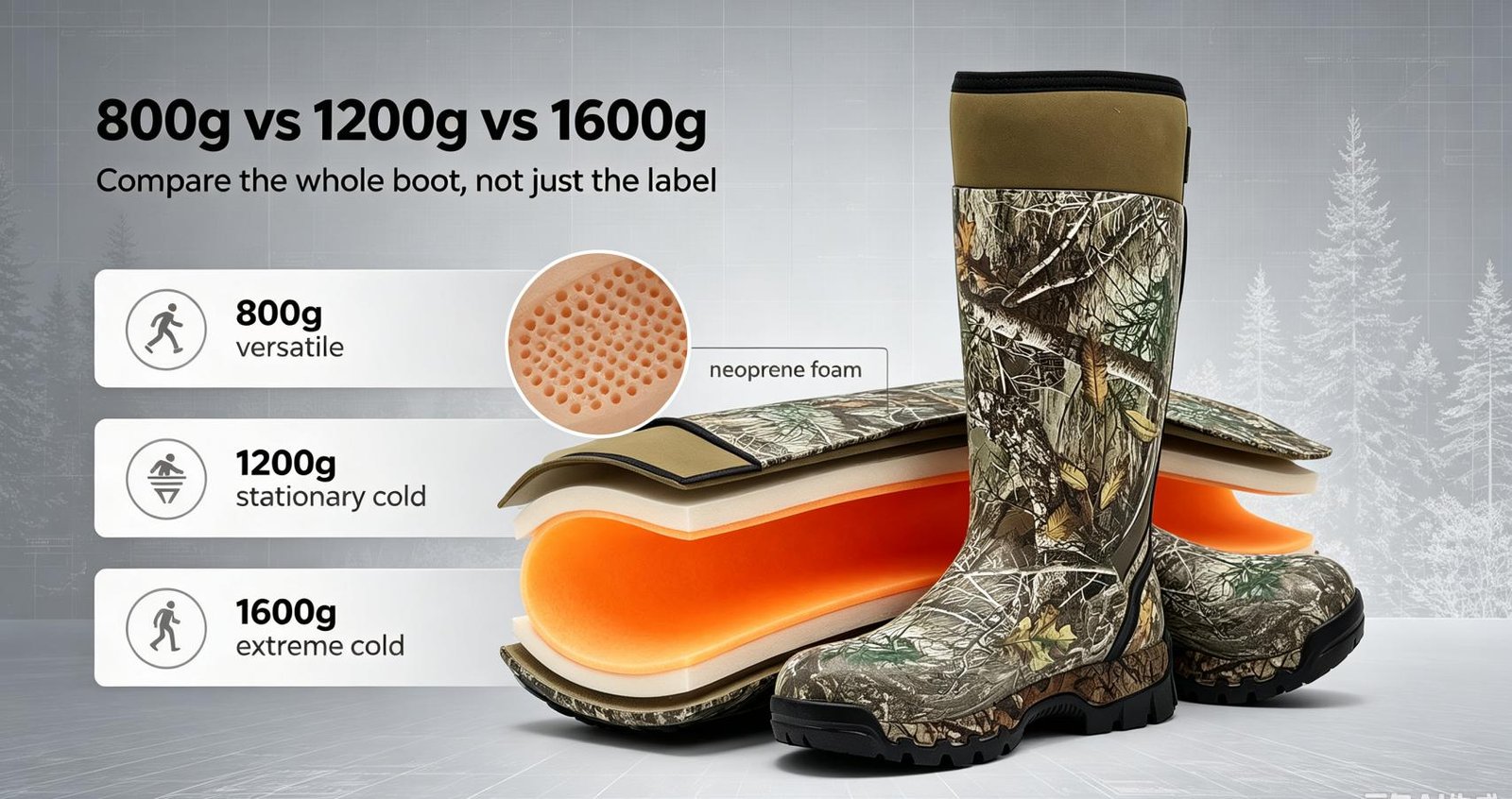
Insulation weight is one of the most visible selling points in cold‑weather hunting boots, but it is also one of the most misunderstood. An 800g, 1200g or 1600g label usually describes the nominal weight of an insulation material used in a defined area or construction. It is not, by itself, a guaranteed temperature rating.
Warmth depends on the complete boot: insulation placement, compression, lining, footbed, outsole, rubber shell, fit, socks, moisture, wind, ground contact, circulation, activity level and duration of exposure. For brands and distributors, the right specification should begin with the hunt scenario—not with the biggest number on the hangtag.
1.Quick Selection Guide
| Insulation level | Typical positioning | Best starting scenario | Trade‑off to manage |
| 800g | Versatile cold‑weather | Mixed walking and waiting; cool‑to‑cold seasons | May be insufficient for long stationary exposure in severe cold |
| 1200g | Heavy cold‑weather | Lower activity, colder ground and longer waits | More bulk, weight and heat during active movement |
| 1600g | Extreme‑cold positioning | Very low activity or severe cold programs | Maximum bulk and drying/fit challenges |
These are product‑positioning starting points, not universal temperature promises. Validate the final boot through controlled testing and field trials in the intended environment.
1.1 800g Insulated Hunting Boots
An 800g construction is often chosen for hunters who alternate between walking and waiting. It can provide a useful balance among warmth, flexibility, weight and internal volume. This positioning suits many general cold‑weather programs where the wearer remains moderately active.
For an OEM project, clarify whether the insulation surrounds the whole foot, extends through the shaft or is concentrated in specific zones. Also assess the footbed and outsole because conductive heat loss into frozen or wet ground can be significant.
Best fit for the assortment
- A core insulated SKU for broad fall and winter use.
- Hunters who walk meaningful distances before taking a stand.
- Retail programs that need warmth without the maximum bulk of an extreme‑cold boot.
1.2 1200g Insulated Hunting Boots
A 1200g specification moves the product toward colder conditions and lower activity. It may suit tree‑stand hunting, cold wetland use or markets where consumers expect a visibly higher insulation story. The development challenge is to add warmth while protecting fit, heel hold and mobility.
Extra insulation occupies volume. If the last is not adjusted, the boot may feel tight, compress the insulation and reduce circulation—exactly the opposite of the intended result. Fit trials should use the socks and footbed expected in real use.
1.3 1600g Insulated Hunting Boots
A 1600g boot is usually positioned for severe cold, long stationary periods or customers who prioritize maximum warmth. It can create a strong premium or specialist SKU, but it is not automatically the best choice for every cold market. Highly active users may overheat, sweat and later feel colder when activity stops.
Brands should pay particular attention to drying time, total boot weight, shaft flexibility, entry opening and size allowance. Field evaluation should include walking, standing and repeated on‑off use rather than a short indoor fitting.
2.Five Factors More Important Than the Number Alone
- Activity level: walking generates heat; stationary hunting does not.
- Fit and circulation: a tight boot or thick sock combination can restrict blood flow.
- Moisture management: sweat and external moisture can reduce comfort and perceived warmth.
- Ground insulation: the footbed, midsole and outsole influence heat loss through the sole.
- Exposure time and conditions: wind, wetness, snow depth and duration change the thermal load.
3.How Brands Should Structure an Insulated Boot Range
Instead of making one boot serve every consumer, build a clear ladder. An uninsulated or lightly insulated model can cover mild weather and high activity. An 800g model can serve as the versatile core. A 1200g model can address colder or more stationary use. A 1600g model can be reserved for extreme‑cold positioning. Keeping a consistent design language across the range helps consumers understand the upgrade path.

4.OEM Development Checklist
- Define climate, hunting style, activity pattern and maximum continuous exposure.
- Specify exactly where the insulation is used and how its stated weight is measured.
- Confirm boot last volume with the intended sock and footbed.
- Select rubber and neoprene thickness for flexibility, protection and weight.
- Match outsole lug geometry to mud, snow, ice, forest floor or mixed terrain.
- Agree on thermal, waterproof, flex and wear‑test methods before making claims.
- Use field trials across representative sizes, not only one development sample.

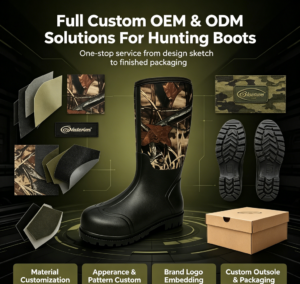
Customized hunting boots service display
5.Avoid Unsupported Temperature Ratings
A temperature claim such as “rated to -30°C” can influence safety expectations and purchase decisions. Because laboratories, test methods, activity assumptions and individual tolerance differ, brands should document the basis of any rating. If the product has not been tested under an appropriate protocol, describe its construction and recommended use without promising a precise comfort limit.
6.Frequently Asked Questions
6.1 Is 1600g always warmer than 1200g?
In an otherwise identical, correctly fitted construction, more insulation may improve thermal resistance. In real products, differences in placement, compression, fit, footbed, lining and moisture can change the result. Compare complete boots, not labels alone.
6.2 Is 800g too warm for walking?
It depends on weather, pace and the individual. An 800g product is often positioned for mixed activity in cold conditions, but high‑output walking in mild weather can cause overheating.
6.3 Should a brand offer every insulation level?
Not necessarily. Analyze customer use, climate zones, retail price points and inventory complexity. Two well‑defined models can outperform four overlapping SKUs.
7.Develop Insulated Hunting Boots for Your Market
Hengrun Outdoor supports private‑label hunting boot development with customizable insulation, rubber and neoprene structures, outsole patterns, camouflage, sizing and packaging. Share your destination market, hunt type and expected price position so the product can be engineered around real use.
Explore insulated hunting boots and OEM options
CTA: Discuss your cold‑weather boot project
Recommended External References:
LaCrosse Footwear – How much insulation do I need?
CDC/NIOSH – Cold stress guidance