A wader can look perfect and still leak at a seam intersection, stocking attachment or tiny surface puncture. For brands and distributors, leakage is more than a product defect: it creates returns, negative reviews, replacement freight and loss of trust during a short selling season.
Reliable quality control starts before the finished‑wader test. Fabric, seam design, tape selection, welding or bonding parameters, operator control and handling all influence waterproof performance. This guide explains the main inspection stages and shows buyers what to confirm before approving mass production.
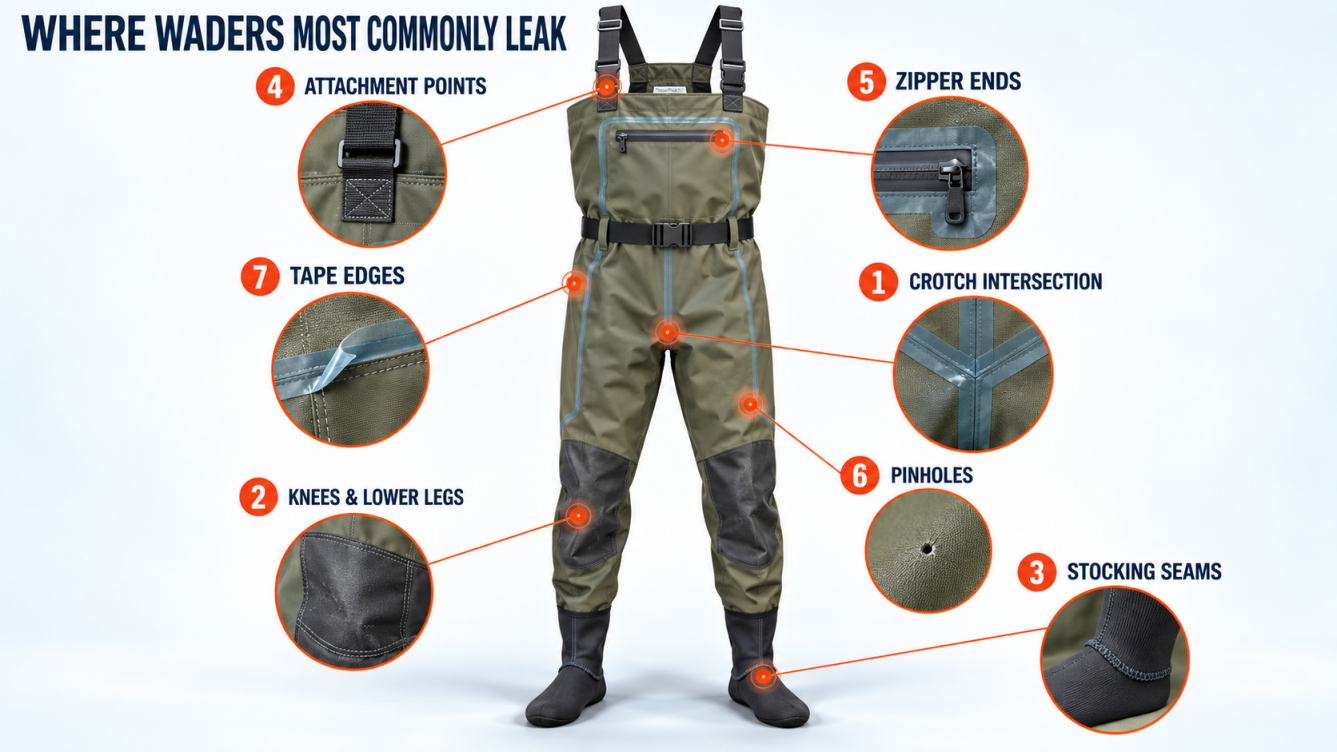
1.Where Do Waders Most Commonly Leak?
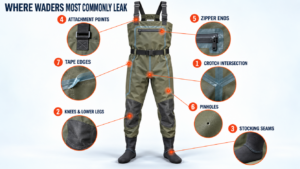
- Crotch intersections where several seams and tape layers meet.
- Knee and lower‑leg zones exposed to abrasion, folding and kneeling.
- Stocking seams, boot attachments and transitions between different materials.
- Pocket, belt‑loop, suspender and accessory attachment points.
- Zipper ends or waterproof‑zipper installation zones.
- Pinholes caused by needles, sharp tools, rough handling or contaminated work surfaces.
- Tape edges affected by incorrect temperature, pressure, speed or material compatibility.

7 Common Leak Points in Wader
2.A Seven‑Stage Wader Quality‑Control Process
2. 1 Incoming Fabric and Component Inspection
Before cutting, the factory should verify material identity, width, shade, visible defects, coating or lamination consistency and agreed physical properties. Seam tape, adhesive, neoprene, stockings, boots, buckles and zippers should be checked for compatibility with the approved specification. Mixing visually similar but incompatible materials can cause delayed seam failure.
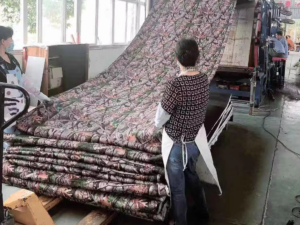
2.2 Cutting and Panel Control
Cut components should be protected from sharp edges, dirt and uncontrolled stacking. Grain or stretch direction, left/right parts, reinforcement placement and size identification must follow the approved pattern. A dimensional check at this stage prevents the operator from trying to “force” misaligned panels together later.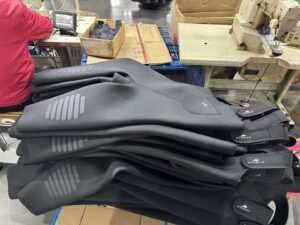
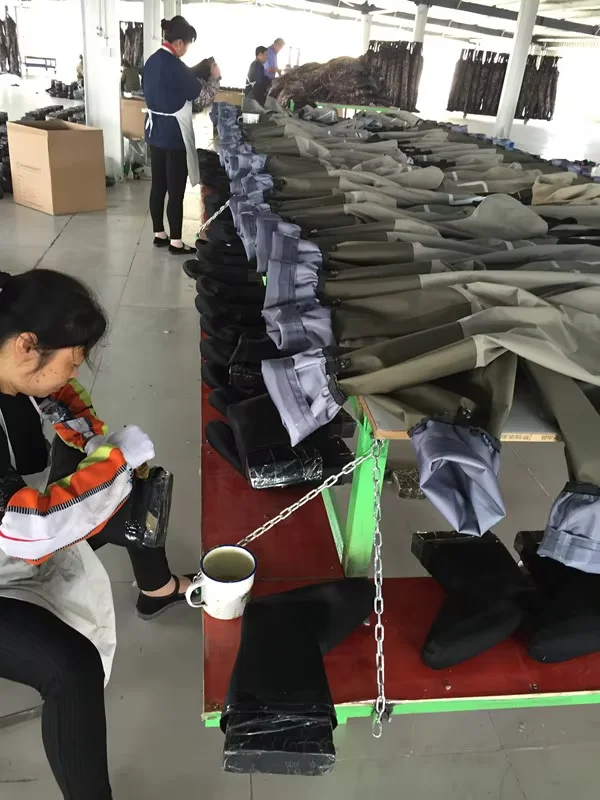
2.3 Sewing, Welding or Bonding Control
The appropriate process depends on the material and product design. Needle size, stitch density, seam allowance, welding settings and adhesive application should be defined in work instructions. Operators need approved reference samples and routine machine checks. Process parameters should be adjusted only through controlled trials.
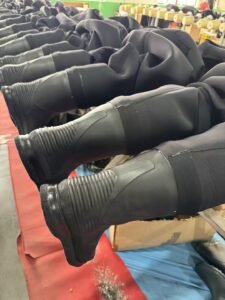
2.4 Seam‑Tape Inspection
For taped breathable waders, inspectors should look for continuous coverage, centered tape, correct overlap, secure edges and smooth treatment at curves and intersections. Wrinkles, channels, scorching, narrow coverage or lifted edges can become leakage paths. Tape adhesion should be assessed after conditioning when required, because a seam that looks acceptable immediately may change after cooling or aging.
2.5 In‑Process Leak Detection
Testing selected semi‑finished units can identify a process drift before an entire batch is completed. The method may use controlled air pressure, water, localized detection liquid or another validated system. The factory and buyer should agree on test parameters because excessive pressure can damage a product, while insufficient pressure may miss relevant defects.
2.6 Finished‑Product Inspection
Final inspection should cover workmanship and function: measurement, seam appearance, stockings or boots, suspenders, buckles, pockets, zipper operation, logos, labeling and packaging. Waterproof testing should be recorded by order, size or production lot according to the agreed quality plan.
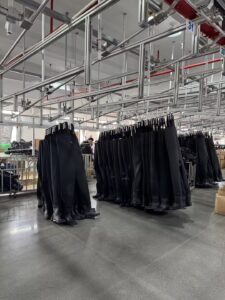
2.7 Corrective Action and Traceability
Finding a leak is not enough. The factory should mark its location, identify the failure mode, trace the operator or process lot, repair only when an approved method exists and retest the product. Repeated defects require root‑cause action—such as changing tape settings or handling—not simply more final inspection.
3.Common Wader Leak‑Test Methods
| Method | How it works | Strength | Limitation |
| Air‑pressure detection | The garment is inflated under controlled conditions and leakage is located by an agreed detection technique. | Fast and useful for production screening. | Requires validated pressure, fixtures and operator discipline. |
| Water‑fill or immersion method | Water is placed inside or the pressurized garment is exposed to water to reveal leakage. | Easy to understand and visually persuasive. | Heavy, slow and potentially stressful to the product if poorly controlled. |
| Localized seam test | High‑risk seams or coupons are tested separately. | Useful for process setup and root‑cause work. | Does not prove the entire finished garment is leak‑free. |
| Hydrostatic‑head fabric test | A fabric specimen resists increasing water pressure under a defined test method. | Quantifies material resistance. | Tests fabric, not complete garment construction. |
4.What Buyers Should Put in the Quality Agreement
- The exact leak‑test method, pressure or water level, duration and conditioning.
- Sampling plan or 100% test requirement for finished goods.
- Definition of a failure and rules for repair, retest and lot escalation.
- Critical zones requiring additional checks, such as crotch and stocking seams.
- Approved material specifications, seam tape and machine settings under change control.
- Inspection records, defect photos, lot traceability and retention samples.
- Requirements for third‑party inspection or laboratory confirmation.
5.Sample Approval Checklist for Importers
- Compare the sample with the signed specification and approved material swatches.
- Check key measurements while the garment is relaxed and on a suitable wearer or form.
- Bend, squat and step to evaluate crotch strain, knee position and stocking comfort.
- Inspect every tape intersection and transition under good lighting.
- Run the agreed waterproof test and keep photos or video of the setup and result.
- Conduct a realistic wear trial, including entry, exit, walking and kneeling.
- Freeze an approved reference sample before authorizing bulk production.
6.Repairability and After‑Sales Support
Some minor punctures and seam issues can be repaired, but the repair system must match the material. A brand should prepare consumer‑care instructions, patch materials where appropriate and a clear warranty process. Analysis of return locations can also reveal design improvements for the next production run.
7.Frequently Asked Questions
7.1 Should every pair of waders be leak‑tested?
The decision depends on product risk, construction, process capability, order history and commercial requirements. Many buyers specify a high level of waterproof screening, but the exact plan should be agreed in writing and supported by in‑process controls.
7.2 Does a high fabric waterproof rating guarantee a leak‑free wader?
No. Fabric performance is only one part of the system. Seams, stockings, boots, zippers, attachments and manufacturing damage can still create leakage.
7.3 Can a leaking wader simply be retaped?
Sometimes, but not always. The cause may be a puncture, contamination, incompatible materials, a poorly formed seam or damaged laminate. The product should be repaired using an approved method and then fully retested.
8.Reduce Returns With Process‑Based Wader QC
Hengrun Outdoor supports OEM/ODM wader development and bulk quality control for fishing, hunting and commercial applications. Buyers can define material, seam construction, reinforcement, boot or stocking configuration, test method, inspection records and packaging as one controlled product specification.
Explore custom fishing and hunting waders
Read more factory and product insights
CTA: Request a sample and quality‑control discussion
Recommended External References:
AATCC – Test methods and textile standards
ASTM International – Textile standards